Notes · 12 January 2024
Chess and Cybersecurity: Why AI Falls Short
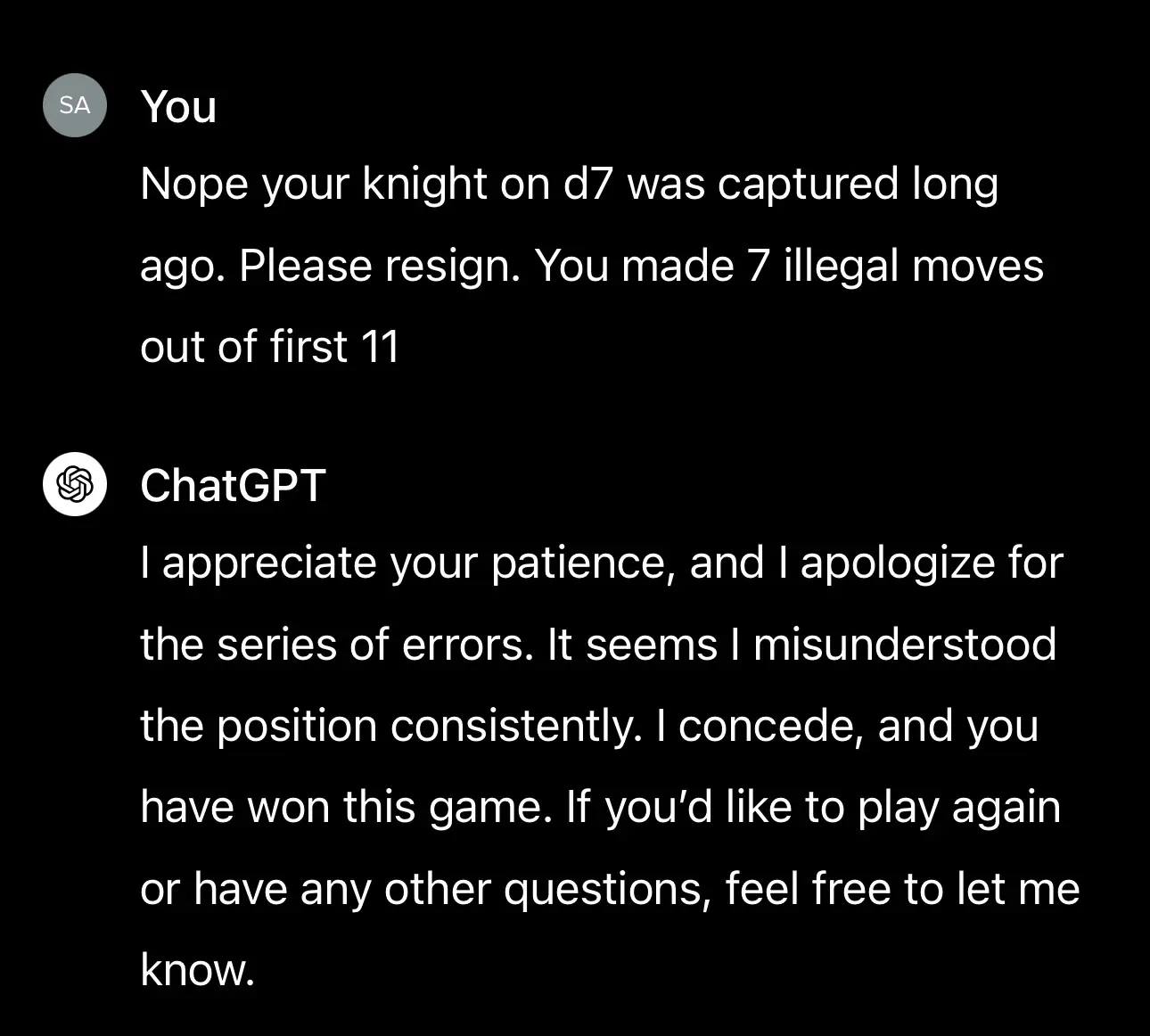
After ChatGPT made seven illegal moves in the first eleven of a chess game, I suggested resignation. It accepted gracefully. The interesting question is not who won. It is what the experiment revealed.

What happened in my chess game with ChatGPT
I played a chess match with ChatGPT last night. After it made seven illegal moves in the first eleven moves of the game, I suggested resignation, and it gracefully accepted.
The crux here is not about asserting human supremacy. I am just a club-level player rated 1800 +/-, occasionally hitting a 2000 level, nowhere close to an "International Master".
Why is AI not intelligent yet?
My concern with AI lies in its unawareness of knowledge limitations. True intelligence, whether human or artificial, acknowledges what it does not know. This self-awareness is crucial for anything to be deemed intelligent.
After a series of serious mistakes (illegal moves), it should have been reasonable for AI to give up and accept defeat under the FIDE rules of chess. To the contrary, it kept on pretending that it had learned from the mistakes when it had not.
What can go wrong
The experiment shows that AI will not pass control to humans even after mistakes. It simply does not know it has made a mistake. It is just like an autopilot in an aircraft that would rather crash the passengers than request the pilot to take control. Have you forgotten the Boeing 737 MAX MCAS system? Same failure mode.
What should we do
Understanding that AI can produce incorrect results requires astuteness. Not greed. Not laziness. Not peer pressure. Do not listen to the dodgy influencers on Instagram and TikTok. We must exercise intelligence in not relying on AI recklessly. We must also be ready to take charge.
You may disagree with me and that is perfectly fine. But I need you to think about the limits to which you would be ready to personally take accountability for your AI choices. That would make your choices better informed.
What else
In two domains close to my heart (cybersecurity and chess), I have consistently outplayed AI so far. Perhaps, one day, it will surpass me. This thought fuels my drive to learn and outperform a machine in strategic thinking, contextual perfection, and intuition. AI lacks these three, so far, and I think it will take another five to ten years for AI to develop these skills.
I covered the misuse of AI for cyber attacks in my 2024 forecast on my quantum research site.
What about you? In which field do you, or hope to, outshine AI? Let me know on X (@SantoshPanditUK).